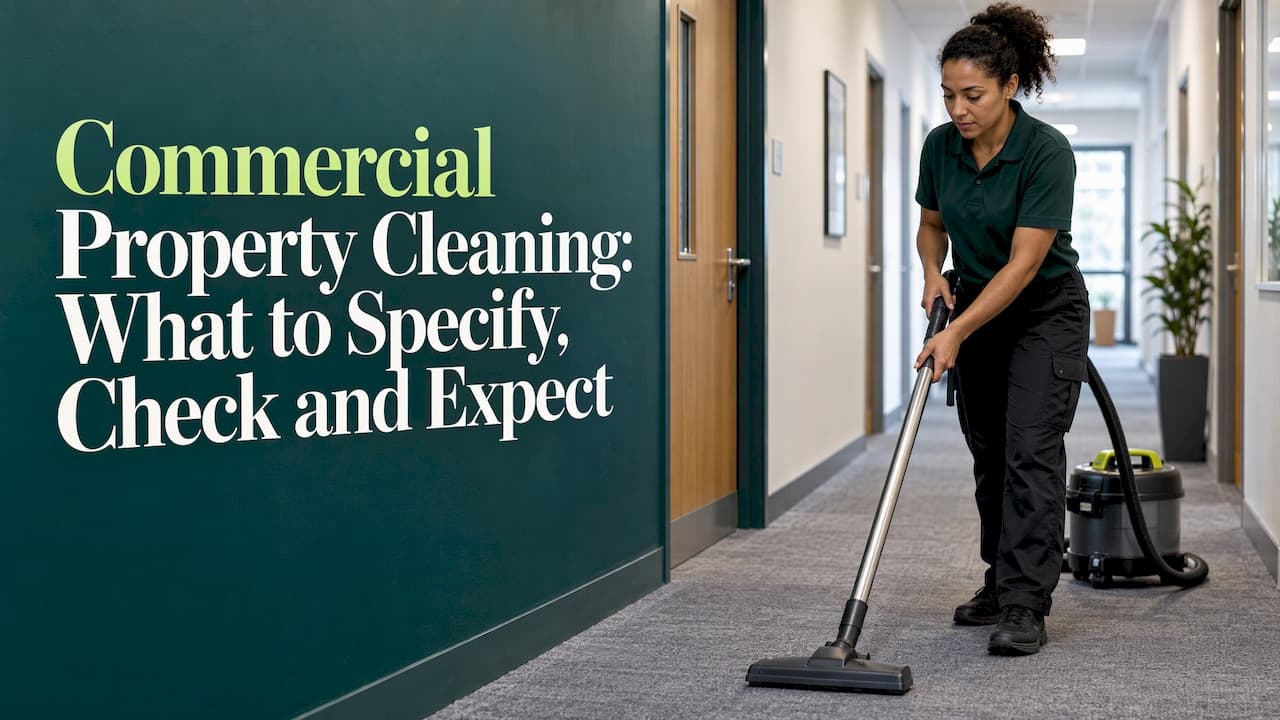
Commercial property cleaning is a regular, scheduled service that keeps offices, shops, workshops and shared areas clean, hygienic and presentable. It is built around a written specification: which areas, which tasks, how often and to what standard. The better that specification, the easier it is to compare quotes and to tell whether the work is being done. This guide explains what is usually included, how to set frequencies, what to check before you hire, and what shapes the price.
TL;DR
- A good service starts with a written specification covering areas, tasks, frequencies and access hours, not a vague promise to "clean the office".
- Frequency depends on the area: washrooms and entrances need attention far more often than a quiet storeroom.
- Before hiring, check insurance, DBS checks, who supplies products and equipment, and how COSHH is handled.
- Price follows size, frequency, specification and access hours, so a quote based on your actual premises is more useful than a generic rate.
- We quote commercial work in Manchester and surrounding areas to the scope you need, with cleaners who are DBS checked and fully insured.
Table of Contents
- What commercial property cleaning usually includes
- How cleaning changes from one type of premises to another
- How often should business premises be cleaned?
- Why we start with a deep clean
- What to check before you hire a commercial cleaner
- What affects the price
- Get a quote for your Manchester premises
- A simple checklist for comparing quotes
- FAQ
- Sources
What commercial property cleaning usually includes
A typical office specification covers internal areas such as offices, washrooms, corridors, stairs, entrances, lifts, kitchens, dining areas and stores, with tasks for waste, floors, furniture and fittings. Other premises add their own zones: a retail unit has a shop floor and fitting rooms, a gym has changing rooms and equipment, a warehouse has welfare areas and walkways.
In practice the work falls into three groups.
Daily or routine tasks
These are the jobs that keep a building usable day to day:
- Emptying bins and removing waste
- Cleaning and restocking washrooms
- Vacuuming carpets and mopping hard floors in busy areas
- Wiping desks, door handles, kitchen surfaces and other touch points
- Cleaning entrances, reception areas and glass at the door
Periodic tasks
These happen weekly, monthly or quarterly. Examples are full floor cleaning, internal window cleaning, dusting high surfaces, cleaning behind and under furniture, and descaling taps and fittings.
Deep cleans
A deep clean resets the building. The same specification models used in the public sector describe the end result in visible terms. The BICSc table reproduced in a Hounslow Council specification describes floors free from spillages, removable stains and loose debris, and washrooms that are dry, odour-free and free from impacted debris, dust, fats and scale after deep cleaning. That is a useful yardstick: it describes what you can see on the day, so you can check it.

Government guidance for schools makes the same split. Routine cleaning covers toilets, furniture, floors, corridors, staff rooms and windows, while periodic or non-routine work can be done during holidays, including a whole-building summer deep clean. Offices, shops and workshops follow the same logic with quieter weekends, bank holidays or shutdown weeks.
How cleaning changes from one type of premises to another
No two buildings need the same plan. The British Cleaning Council's 2025 framework says cleaning and hygiene policies should be tailored to each environment's needs and challenges, by assessing risks, usage and occupant density, then setting standards, methods and frequencies for each area. It names settings such as leisure, retail, hospitality and public transport.
Here is how that looks in practice for common Manchester business premises:
| Premises | What drives the specification | Typical focus |
|---|---|---|
| Office | Number of staff, desk use, shared kitchens | Washrooms, kitchens, floors, touch points |
| Retail unit | Customer footfall, opening hours | Entrance and shop floor, glass, fitting rooms |
| Gym or studio | Heavy use, moisture, shared equipment | Changing rooms, showers, floors, equipment wipe-downs |
| Hospitality | Food areas, late finishes | Kitchens, dining areas, toilets, floors |
| Warehouse or workshop | Dust, large floor area, small staff team | Welfare areas, offices, walkways, dust control |
The idea of levels is also useful. HEFMA's contract-cleaning guide separates basic, standard and superior cleaning: standard is the normal office level, while superior intensifies methods or frequencies to protect finishes, investment or commercial image. A solicitor's reception or a showroom may justify superior cleaning in the public areas and standard cleaning behind the scenes. A sensible quote lets you mix levels like this rather than paying for the highest level everywhere.
How often should business premises be cleaned?
There is no single answer, because frequency should vary by area. HEFMA's example is that a heavily trafficked lobby or lift needs thorough vacuuming daily, while lightly trafficked areas may need it only periodically.
The BICSc table published by Hounslow Council gives a worked office example: five days a week, internal cleaning, average-use working areas, with waste removal and washroom cleaning five times a week. In the same table, soft floors get a full suction clean once a week and hard floors a full mop once a week, with spot cleaning more often in between.
As a starting point, you can think in these bands, then adjust to your own building:
- Every working day: washrooms, waste, kitchens and break areas, reception and entrances.
- Weekly: full vacuuming and mopping of main floors, dusting of accessible surfaces, internal glass.
- Monthly or quarterly: high-level dusting, skirting boards, upholstery, vents, deeper washroom descaling.
- Once or twice a year: a full deep clean, plus specialist work such as carpet cleaning.
A schedule should do more than list times. The British Council framework defines it as a plan stating the tasks, timing, frequency and responsible person, and says schedules support consistency, accountability and the prevention of build-up. If your current arrangement has no named person and no task list, that is the first thing to fix.
Why we start with a deep clean
We begin every regular cleaning package with a thorough initial deep clean. The reason is simple: a maintenance clean is designed to hold a standard, not to create it. If grime has built up in washrooms, kitchens and floor edges, routine visits spend their time fighting the backlog. A deep clean first gives the regular service a fresh, agreed baseline to maintain.
That baseline also helps you. You can see what the building looks like when it is properly clean, and every later visit can be judged against it. For commercial premises we quote the initial clean and the ongoing schedule together, based on the condition of the property and your specific requests.
What to check before you hire a commercial cleaner
Most problems with commercial cleaning come from a loose brief or from assumptions nobody wrote down. These are the checks worth making.
Write the specification before you ask for quotes
Government guidance says a cleaning specification should identify cleaning weeks per year, routine and non-routine work, access hours and day-to-day duties, and cover quality monitoring, staffing and resource responsibilities. Although it is written for schools, the same headings work for any business.
HEFMA adds that a tender specification should describe the building and occupants, the areas served, required methods and frequencies, and the total cleanable floor area. It warns that vague wording such as "vacuum carpets" makes tenders incomparable. Say how often, which areas, and with what result. Then every supplier is pricing the same job.
Insurance and staff checks
The same government guidance advises asking contractors to take out indemnity insurance, completing DBS checks to the appropriate level, and considering staff training in COSHH and health and safety. Our cleaners are DBS checked and fully insured, which matters when staff are in your building out of hours with access to desks, stock and keys.
Products, equipment and COSHH
Cleaning products can be hazardous. HSE's COSHH guidance says cleaning can expose workers to hazardous substances, and that employers should organise workplaces for effective cleaning, provide safe spill procedures and use dust-free methods such as vacuuming rather than sweeping. It also says PPE should not automatically be the control measure: it is provided alongside other controls where exposure cannot otherwise be adequately controlled.
Where dust is a factor, as in workshops and warehouses, HSE's EH44 guidance says dry sweeping, compressed air and other methods that make dust airborne should not be used for cleaning. It also says dust assessments must address the hazard, exposure route, controls and emergency arrangements, with written significant findings required where five or more people are employed. If your premises produce dust, tell your cleaning provider at the quoting stage so the method suits the site, and speak to your health and safety adviser about your own assessment.
We supply our own products and equipment, so you do not need to stock a cupboard or buy machines. Tell us about any sensitive surfaces, food areas or dusty zones when we discuss scope.

Access, keys and timing
Decide when cleaners can enter, who holds keys or codes, how alarms are handled and what happens if the building is occupied. Early mornings and evenings suit most offices, and shops often clean before opening. Agreeing this at the start avoids missed visits.
Extras
Carpet cleaning, exterior cleaning and one-off deep cleans are often wanted alongside the routine visit. We discuss extras openly rather than assuming them, so what you pay for matches what you asked for.
What affects the price
Commercial cleaning is usually priced to the job rather than from a fixed menu. The main drivers are:
- Size of the premises and the number of washrooms and kitchens
- Frequency: daily, weekly or fortnightly visits
- Specification: basic, standard or superior cleaning in each area
- Access hours: evening, early morning or weekend work
- Condition on arrival: a neglected building needs a bigger first clean
- Extras: carpets, windows, exterior areas or specialist surfaces
Published guides from industry sites quote wide ranges for UK hourly rates and monthly contracts, which shows how much depends on the factors above. A generic figure tells you little about your own building. A written quote that matches your specification tells you far more.
We do not publish a price for commercial cleaning. We agree the scope and the quote with you before booking, based on your property and requirements, and you pay after the quote is agreed and the service is delivered.
How we think about commercial cleaning
Most businesses we speak to do not need a complicated contract. They need a clean building, reliable people and no surprises on the invoice.
That is why we start with a deep clean, then move to a regular schedule that holds the standard. Everything is agreed first: areas, frequency, extras and price. We bring our own products and equipment, and our cleaners are DBS checked and fully insured.
We would rather spend time on a proper scope at the start than argue about it later. When the specification is clear, both sides know what a good visit looks like.
the author
Get a quote for your Manchester premises
If you run an office, shop, studio or workspace in Manchester or the surrounding area, we can quote for the initial clean and the regular service together. Tell us the size of the building, the areas you want covered, how often, and any access limits. We will agree the scope and the price with you before anything is booked.

See our commercial cleaning service to request a quote. If you also look after a home and want it cleaned to the same standard, our deep cleaning and fortnightly cleaning pages explain how that works.
A simple checklist for comparing quotes
Use this list with every supplier so you compare like with like:
- Is the scope written down by area, with tasks and frequencies?
- Is the level (basic, standard or superior) stated for each area?
- Does the quote say who supplies products and equipment?
- Is insurance confirmed, and are cleaners DBS checked?
- Are access hours, keys and alarm arrangements agreed?
- Is there a named person responsible for the schedule?
- Is the first clean priced separately from the ongoing service?
- Are extras such as carpets, glass and exterior work listed with how they are charged?
If a quote cannot answer these, ask for it to be reissued with detail. A supplier confident in its service will have no problem putting the scope in writing.
FAQ
What does a commercial property cleaning service include?
It normally covers waste removal, washrooms, kitchens, floors, surfaces, entrances and communal areas, with periodic tasks and deep cleans on top. The exact list depends on your premises and is set out in the specification. We agree it with you before the first visit.
How often should an office or shop be cleaned?
It depends on the area. Washrooms, kitchens and entrances usually need daily attention, while floors, dusting and glass often work weekly, and deeper tasks monthly or yearly. A public-sector office example uses five visits a week, so many small businesses choose fewer visits and focus them on high-use areas.
Do I need a deep clean before starting regular cleaning?
We recommend it. A deep clean sets a clean baseline so that regular visits maintain it rather than catch up on a backlog. We start every regular package this way.
What should I ask a commercial cleaner about insurance and safety?
Ask whether they hold insurance, whether staff are DBS checked, who supplies products and equipment, and how they handle hazardous substances under COSHH. Our cleaners are DBS checked and fully insured. Tell us about any dusty areas, food zones or delicate surfaces so we can plan the method.
How much does commercial cleaning cost in Manchester?
It depends on size, frequency, specification, access hours and the condition of the building. We quote commercial work to your scope and agree the price before booking, so you know what you will pay before any work starts.
Sources
- A Guide to Contract Cleaning (HEFMA)
- BICSc Cleaning Standards Specifications Table (Hounslow Council)
- Strategic Framework for Achieving Cleanliness and Hygiene (British Cleaning Council, 2025)
- Buying for schools: cleaning services (GOV.UK)
- How to carry out a COSHH risk assessment (HSE)
- Dust in the workplace: general principles of protection, EH44 (HSE)