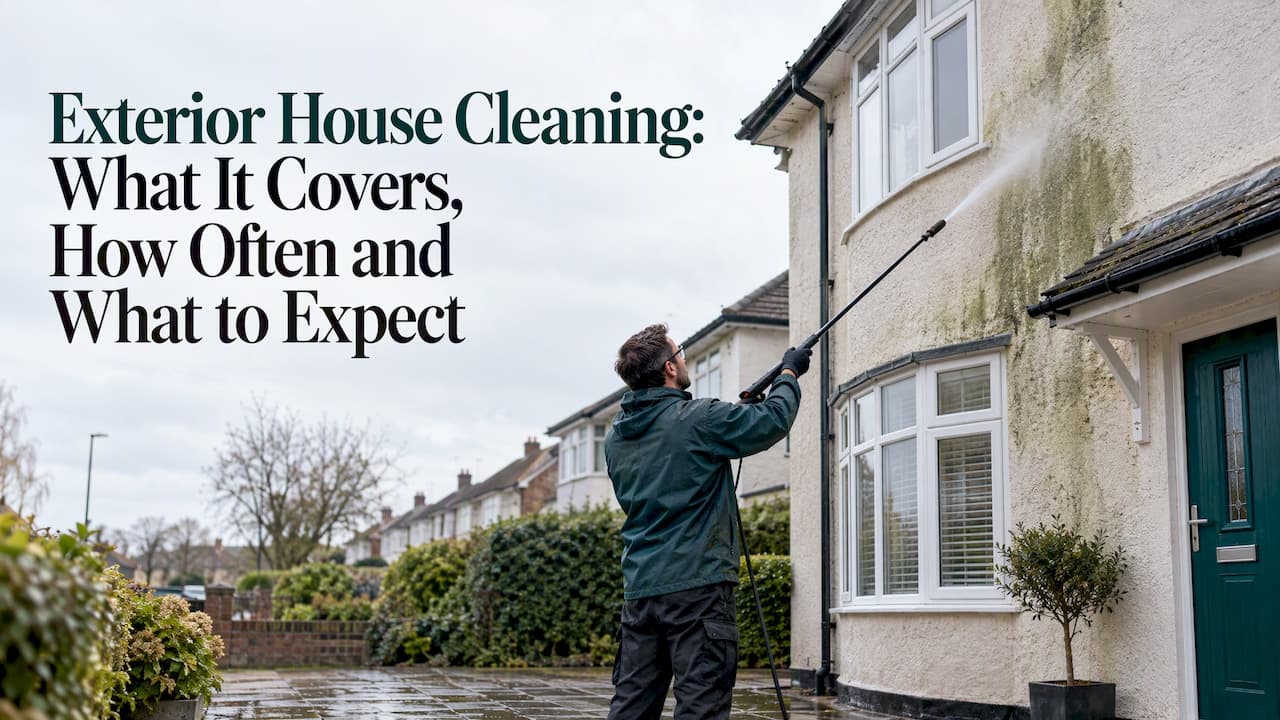
Exterior house cleaning is the removal of dirt, algae, moss, lichen and general grime from the outside of your home: walls, render, brickwork, roof, gutters, windows, driveways, patios and decking. Most homes need it once or twice a year. The right method depends on the surface, not on whichever machine the cleaner owns. In Manchester's damp climate, shaded walls and paving green over quickly, so a regular clean protects both the look of the house and the materials underneath.
This guide explains what is normally included, how often to book, which methods suit which surfaces, what the rules say about wastewater, what affects the price and how to brief a cleaner so the quote matches the job.
TL;DR
- Exterior house cleaning covers walls, roofs, gutters, windows and hard surfaces such as drives and patios. The scope should be agreed in writing before work starts.
- Plan on one or two cleans a year, or every six to nine months where you have trees, heavy pollution or sea air.
- Choose the method by material. Pressure suits tough surfaces. Gentler, low-pressure approaches suit render, painted masonry and older brick.
- Roof work involves working at height and should only be done by trained, insured people. Wastewater must not carry pollution into surface water drains.
- We quote exterior cleaning for Manchester homes and businesses job by job, so you pay for the scope you actually need.
Table of Contents
- What exterior house cleaning actually includes
- How often should you arrange it?
- Which method suits which surface
- Safety: roofs, ladders and pressure washers
- Is pressure washing a driveway legal?
- What affects the price
- Planning external cleaning for a commercial building
- How to get an accurate quote
- Our perspective
- Exterior cleaning with Thorntons Property Care
- FAQ
- Sources
What exterior house cleaning actually includes
There is no single standard package, which is why two quotes for "exterior cleaning" can differ wildly. The work usually falls into a handful of areas, and a good quote names each one you want.

Walls and facade. Brickwork, render, stone, cladding and painted masonry. The main targets are green algae, black staining, lichen and weathering grime, which build up on north-facing and shaded elevations.
Roof and gutters. Moss and lichen removal from tiles, and clearing leaves and silt from gutters and downpipes. This is the highest-risk part of the job because of the height involved.
Windows, frames and fascias. uPVC frames, soffits, fascias and glass. These collect dust, spider webs and green film, and often make the biggest visual difference for the least effort.
Hard surfaces. Driveways, paths, patios and decking, plus garden walls and steps. These are the surfaces people most often tackle themselves with a pressure washer.
Specialist items. Conservatory roofs, porches, garage doors, outbuildings and fencing. They are easy to forget when requesting a quote, so list them.
It helps to walk around the house before you call anyone and photograph each elevation. Note what is stained, what is high up and what is fragile, such as old pointing, cracked render or loose tiles. A cleaner who sees the photos can quote far more accurately than one working from a postcode.
How often should you arrange it?
For most homes, a general exterior clean once or twice a year is the usual advice, and every six to nine months where pollen, pollution, sea air or overhanging trees speed up the build-up. The same source quotes a professional cleaner who recommends once or twice a year to look after the materials and avoid costly repairs.
A sensible rhythm for a typical Greater Manchester house looks like this:
| Area | Typical rhythm | What speeds up the build-up |
|---|---|---|
| Windows, frames, fascias | Several times a year | Traffic, nearby building work |
| Gutters | At least once a year, ideally after leaf fall | Overhanging trees |
| Walls and render | Every one to two years | Shade, north-facing walls, damp |
| Roof | When moss is visible, not on a fixed timetable | Trees, shade, low pitch |
| Drive, patio, decking | Once a year | Shade, leaf litter, heavy use |
This table is a planning guide, not a rule. Look at the house after a wet autumn and again in spring. If green or black patches are spreading, the clean is due. Leaving algae and moss to build up is usually what turns a light clean into a heavy one, and heavy cleans cost more.
Which method suits which surface
The single most useful thing to understand is that exterior cleaning is material-specific. Kärcher's professional facade guidance lists plaster, natural stone, glass, metal and wood as typical facade materials, and says professional cleaning may use high-pressure cleaners, sand or wet blasting, dry-ice blasting and suitable brushes depending on the material and the dirt. In other words, brushes, pressure and cleaning agents should be chosen for the facade and the type of dirt, not applied the same way everywhere.
In practice, that means asking about method for each surface:
- Hard, durable surfaces such as concrete paving, block paving joints or robust stone usually tolerate higher pressure, though even here a close nozzle can etch the surface or wash out jointing sand.
- Render, painted masonry, soft brick and older pointing are easily damaged by force. Water driven into cracks can cause damp problems inside. Lower pressure, a suitable cleaning solution and time to work are the safer route.
- uPVC, glass and cladding respond well to soft brushing and a gentle rinse.
- Timber decking and fences can splinter or furr if the pressure is too high.
- Roofs need a careful approach because the tiles are weathered and the access is hazardous.
A good question to put to any cleaner is: "What will you use on the render, and what will you use on the drive, and why?" If the answer is the same for both, keep looking.
Algae and green staining on walls
Green or black film on walls is mostly biological growth. Blasting it off with force can leave the surface looking clean for a short while but may damage the face of brick or render. The better approach is to treat the growth with a suitable solution, allow it to work, and rinse gently. Ask the cleaner how they will protect plants, windows and electrics around the wall, and what happens to the runoff. Algae can return within a season or two on shaded walls, which is why many homeowners settle into an annual or two-yearly rhythm.
Safety: roofs, ladders and pressure washers
This is the part where a cheap quote can turn expensive. Working at height is dangerous, and it is the reason roof and gutter work belongs with trained, insured people rather than a weekend ladder.
The Health and Safety Executive's guidance on roof work says work at height must be planned to prevent or minimise risk, following the hierarchy in the Work at Height Regulations, and that falls account for a quarter of workplace deaths in Great Britain. It also says operatives should be competent and trained, and that access equipment such as a cherry picker (a mobile elevating work platform) may be used. If a contractor plans to walk on your roof with no access equipment, no risk assessment and no insurance, that is your cue to walk away.
Pressure washing has its own hazards. HSE guidance on pressure cleaning external structures, written for offshore work but based on the same physics, notes that spray creates mists that may contain harmful substances, so respiratory protection is normally needed. It also stresses protecting sensitive electrical fittings from water ingress and never directing spray at people. At home, that translates into covering or avoiding outdoor sockets, meter boxes, lights and alarm sensors, and keeping children and pets indoors during the job.
Before anyone starts work on your property, check four things:
- They carry public liability insurance and will confirm it in writing.
- They can explain how they will reach any high areas safely.
- They know how to protect electrics, windows and plants.
- They have a plan for the wastewater (see the next section).
Is pressure washing a driveway legal?
Pressure washing itself is not banned. The legal issue is where the dirty water goes. Surface water drains, the ones in your road and on your drive, usually discharge straight into the environment without treatment, so detergent, oil and silt must not get into them.
The government's pollution prevention guidance for businesses, which applies to anyone cleaning as a trade, says contaminated water must not cause pollution. Operators can reuse or treat it, collect it for removal by a registered waste carrier, or discharge it to a foul drain with the water company's permission. It adds that drainage plans matter because surface water drains lead directly into the environment, so you need to know which type of drain you have.
For homeowners, the practical points are:
- Ask a cleaner how they manage runoff. A confident answer mentions drain covers, collection or directing water to a foul drain, not "it just washes away".
- If you do a small job yourself, keep detergent and heavy contamination out of road gullies and watercourses.
- If your drive is shared or the drain situation is unclear, ask before work starts.
What affects the price
Exterior cleaning is priced very differently across the market. Some firms charge per square metre, others quote a fixed sum per job, and others work hourly. Whatever the model, the same factors drive the figure:
- Size and number of elevations. A terrace is quicker than a detached house with a garage and conservatory.
- Condition. Light algae takes less time than years of moss and lichen.
- Height and access. Three storeys, steep roofs and tight side passages need more equipment and time.
- Surface type. Delicate materials need slower, gentler methods.
- Extras. Gutters, windows, conservatory roofs, sealing or weed treatment.
- Water and drainage. Collecting wastewater adds time and equipment.
For a sense of scale on one of the most expensive items, one UK price guide puts a typical roof clean for a three-bedroom semi at around £300 to £500, rising to as much as £750 for pressure cleaning and £700 to £1,000 for a large home with an attached garage and conservatory. Treat these as ballpark figures: your own quote will depend on your roof, your location and the access.
When you compare quotes, compare scope line by line. A low price that leaves out gutters, or excludes the north wall, is not a lower price.

Planning external cleaning for a commercial building
For shops, offices, units and rented commercial premises, the same principles apply but the planning is different. Think about:
- Customer-facing areas first. Entrances, shopfronts, signage and windows shape first impressions, so they usually get the most frequent attention.
- Timing. Early mornings, evenings or closed days keep disruption to a minimum, and keep customers away from wet floors and spray.
- Access and safety. Cordoning, signage and a risk assessment for work at height are standard for a professional contractor.
- Drainage. Business premises carry a clearer responsibility under the pollution guidance above, so ask how wastewater will be handled.
- Lease and building responsibilities. Check whether you or the landlord are responsible for the facade, roof and gutters.
- A maintenance schedule. A planned programme across the year is usually cheaper than reactive cleaning after complaints.
If you want the interior and exterior of a business handled by one provider, our commercial cleaning page explains how we approach it.
How to get an accurate quote
A quote is only as good as the brief behind it. To avoid surprises:
- Send photos of every elevation, the roof and the hard surfaces.
- List what you want by area: walls, windows, gutters, drive, patio and anything else.
- Mention access issues such as steep drives, locked side gates, outside taps and power sockets.
- Ask about method for each surface, and about wastewater.
- Ask what is not included so extras are discussed rather than assumed.
- Get it in writing, including insurance details and how long the job should take.
Timing matters too. Gutters are best cleared after the leaves have fallen. Walls and hard surfaces are easier to treat in dry spells, and you will want a few settled days so the surface can dry afterwards.
Our perspective
Most homeowners we speak to do not want a one-off blast of exterior cleaning. They want the whole property to look cared for, inside and out, without managing a string of contractors.
That is why we start every regular package with a thorough initial deep clean, and why we agree scope and price before booking. Our exterior cleaning is quoted to the property: its condition, the surfaces involved and what you ask us to cover. Products and equipment are supplied, our cleaners are DBS checked and fully insured, and extras are discussed openly rather than assumed.
For many Manchester households the sensible plan is simple: a deep clean to reset the home, fortnightly visits to keep it there, and exterior cleaning booked when the weather and the condition of the property call for it. One provider, one conversation about what you need, and no vague line items.
the author
Exterior cleaning with Thorntons Property Care
We provide exterior cleaning for homes and businesses in Manchester and surrounding areas. We do not publish a fixed price for exterior work because the scope varies so much from house to house, so we quote after understanding the property and what you want done. Our cleaners are DBS checked and fully insured, and we bring the products and equipment.

If you are also planning to freshen up the inside, our deep cleaning is priced at £25 per hour, and our fortnightly home cleaning at £20 per hour. Our guide on preparing for a deep clean explains how to get the house ready, and our domestic cleaning page shows how the services fit together. Get in touch through the site for an exterior quote.
FAQ
What is exterior cleaning?
Exterior cleaning is the professional cleaning of the outside of a building and its surroundings. That typically means walls, roofs, gutters, windows, frames, drives and patios. The aim is to remove dirt, algae and moss and keep the materials in good condition.
How often should I have my house exterior cleaned?
Once or twice a year suits most homes. Choose every six to nine months if you live near trees, a busy road or the coast, or if shaded walls go green quickly. Gutters are best checked after autumn leaf fall.
Can I pressure wash my own driveway?
Yes, it is not illegal, but the wastewater must not carry detergent, oil or heavy dirt into surface water drains. Use a suitable pressure for the surface, protect outdoor electrics and keep people clear of the spray. For roofs and anything high up, hire trained, insured people.
How much does exterior cleaning cost?
It depends on the size of the house, the condition, the height and the surfaces. A roof clean alone is often quoted in the hundreds of pounds for a typical semi. We quote exterior jobs individually, so send us photos and a list of what you want done.
Sources
- How often should you have the exterior of your house cleaned? (Homes & Gardens)
- Professional and thorough facade cleaning (Kärcher)
- Pollution prevention for businesses (GOV.UK)
- Health and safety in roof work (HSE)
- Pressure cleaning, external structures (HSE)
- Roof moss removal cost (PriceYourJob)