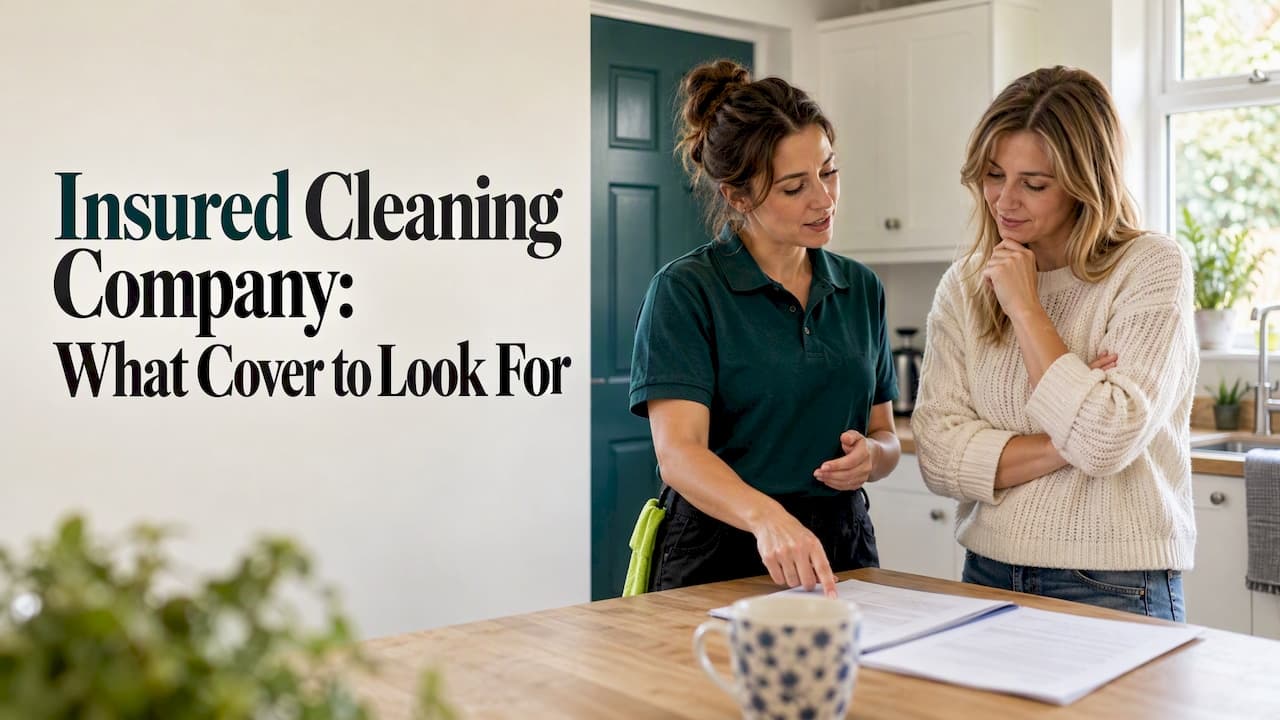
An insured cleaning company holds insurance that pays out if its cleaners injure someone or damage your property while working for you. In the UK, the cover that matters most to you as a customer is public liability insurance. Employers' liability insurance is a legal requirement for any firm that employs staff. Ask to see the policy documents before the first visit, not after something goes wrong.
This guide explains what each type of cover does, how hiring a company differs from hiring a lone cleaner, and the checks worth making before you book. It is written for homeowners and business owners in Manchester and the surrounding area.
TL;DR
- Public liability insurance covers injury to the public and damage to their property caused by the cleaning business. It is the cover customers care about most.
- Employers' liability insurance is a legal requirement once a business employs people. It must provide at least £5 million of cover, and the fine for going without is £2,500 a day.
- Always ask for the policy schedule, check the cover limit and read the exclusions. Look especially for care, custody and control wording and for any work at height.
- Insurance is one check among several. Pair it with DBS checks, a written quote and clear scope.
- Our cleaners are DBS checked and fully insured, and we agree a written quote before you book.
Table of Contents
- What "insured" actually means for a cleaning company
- Public liability: the cover that protects your home or office
- Employers' liability: why it matters even though it is not your policy
- Hiring a company or an independent cleaner
- How to check a cleaning company is properly insured
- Insurance is one check among several
- Our view on insured cleaning
- How our cleaning is priced in Manchester
- Questions to ask before you book
- FAQ
- Sources
What "insured" actually means for a cleaning company
The word gets used loosely. Some firms mean one policy, others mean a bundle. For a cleaning business there are several separate types of cover, and they protect different people.
| Type of cover | Who it protects | Is it a legal requirement? |
|---|---|---|
| Public liability | You, as a member of the public, and your property | No, though customers and letting agents often ask for it |
| Employers' liability | The cleaners who work for the company | Yes, once you employ staff |
| Motor insurance | Anyone affected by business driving | Yes, if vehicles are used for business, including personal ones |
| Equipment insurance | The company's own machinery and tools | No |
| Personal accident | The people named on the policy | No |
The legal items come from official guidance. Business.gov.uk says UK businesses must hold motor insurance if they use vehicles for business purposes, and that includes personal vehicles. It also describes equipment insurance as protection against loss or damage to machinery, tools, stock and essential equipment.
Public liability is not required by law. One insurance broker notes that most one-person cleaning businesses carry it anyway, because clients and letting agents frequently ask for it. For you as the customer, it is the policy that stands between a broken vase and an argument.
Public liability: the cover that protects your home or office
Public liability insurance covers a cleaning business's legal liability for injury to members of the public and damage to their property. In practice, that covers situations like these:
- A cleaner leaves a wet floor and a visitor to your home slips.
- A cleaning product marks a worktop or discolours a floor.
- A cleaner knocks over and breaks something valuable.
- A vacuum cleaner trails a cable and a client or customer trips.
Where a claim arises, the insurer normally assesses it and deals with the client. Where appropriate it pays for repair or replacement. That is the whole point of asking whether a company is insured. You shouldn't have to chase a business for the cost of a damaged item, and the business shouldn't have to pay out of its own pocket.
The "care, custody and control" clause
This is the detail most customers never hear about. Some public liability policies exclude damage to property that the business is working on. Insurers call this care, custody and control. A cleaner who is cleaning your carpet or your oven is, in a literal sense, working on your property.
Broker guidance says cleaners should check for specific extensions covering clients' premises and contents. So ask the company one direct question: does your policy cover damage to the items and surfaces you are cleaning? A reputable company will answer plainly, and can point to the wording.

What public liability does not cover
It is not a catch-all. It will not cover injuries to the business owner or its employees, damage to the owner's own property, or claims arising from negligent advice, so other policies may be needed. That is why a properly insured company holds a combination of covers rather than a single certificate.
Employers' liability: why it matters even though it is not your policy
If a cleaner is hurt in your home, who pays? For a company that employs its cleaners, the answer is the employer's insurance. Employers' liability insurance is required as soon as you become an employer. The government says employers need at least £5 million of cover from an authorised insurer, and can be fined £2,500 for every day they are not properly insured.
The Health and Safety Executive explains the practical effect for domestic work. If someone is employed by an agency or other business to clean in a home, they are covered by their employer's insurance. Domestic workers who are self-employed or hired by an agency are covered by the Health and Safety at Work etc. Act. The employers' liability rules are for Great Britain, which includes Manchester.
For you as the householder, the benefit is simple. When the person in your kitchen is a company's employee, an injury claim goes to the employer's insurer. It does not come to you.

Hiring a company or an independent cleaner
This is the question behind many searches for insured house cleaners. Both routes can work, but the paperwork differs.
| Question | Cleaning company | Independent cleaner |
|---|---|---|
| Who holds public liability? | The company, for all its cleaners | The individual, if they have bought it |
| Who covers an injured cleaner? | The employer, through employers' liability | Usually the cleaner themselves |
| What if the cleaner is ill? | The company can normally send cover | The visit is usually cancelled |
| How easy is it to check? | One policy, one schedule, one contact | You check each person separately |
| Who handles a complaint? | A business with a reputation to protect | A single individual |
With a company, you are checking one set of documents once, and every cleaner who attends is covered by it. With a lone cleaner, you need to ask for the certificate and keep a copy. If you are comparing two quotes, make sure both include the same cover, or the cheaper one may simply be uninsured.
How to check a cleaning company is properly insured
A badge on a website is not proof. Here is a short routine that takes ten minutes.
- Ask for the certificate or policy schedule. A genuine business will send it without fuss. It shows the insurer, the policy number, the cover limit and the dates.
- Check the dates. A policy that expired last month does not protect you today.
- Check the limit. Public liability policies carry a limit per claim. Ask what it is and whether it comfortably exceeds the value of your home contents or office equipment.
- Read the exclusions. Business.gov.uk advises comparing policy documents for cover limits, exclusions and conditions rather than relying on price alone. It also makes the point that if something is not mentioned in the policy documents, it is typically not covered.
- Check the description of work. Not every cleaner needs the same policy. Make sure the policy wording includes everything they actually do, including any work at height or hazardous cleaning.
- Ask who is covered. Employees, subcontractors and anyone the company sends on its behalf should all be named or included.
- Ask about vehicles and equipment. If the team drives to you with machinery, motor cover and equipment cover are part of a professional set-up.
Does the cover match the job?
A regular tidy-up, a deep clean, a carpet clean and an office contract are different risks. A deep clean may involve ladders, descaling products and heavy appliances moved out of position. A commercial contract may involve out-of-hours access and shared premises. Before you book, tell the company exactly what you want done and ask them to confirm the policy covers it. If a company hesitates over that question, that tells you something.
If a cleaner damages something or someone is hurt
It is rare, but it is worth knowing the sequence.
- Make sure nobody is in danger. For an injury, get first aid or call 999 if it is serious.
- Photograph the damage and note the date, time and what happened.
- Tell the company promptly and in writing, so there is a record.
- Do not throw away the damaged item. The insurer may want to see it.
- Let the company notify its insurer. If the matter is not resolved, you can ask for the insurer's details and make the claim yourself.
A responsible company will deal with this quickly. The insurer then assesses the claim and handles the settlement.
Insurance is one check among several
Insurance protects you after something goes wrong. These other checks help prevent problems in the first place.
- DBS checks. A cleaner will be in your home when you are out, and in your office after hours. Ask whether every cleaner is DBS checked.
- A written quote. The scope, hourly rate and any extras should be agreed before the booking, not after the visit.
- Products and equipment. Find out whether the company supplies them. It avoids arguments about what is used on your surfaces.
- Extras discussed openly. Oven cleaning, inside windows and carpets should be priced and agreed, not assumed.
- Local presence. A firm that works in your area has a reputation to protect nearby.
Our view on insured cleaning
We meet people every week who have been burned by a cleaner who was cheap and unprotected. Usually nothing has gone badly wrong. They just never knew who would be responsible if something did.
That is why we think the insurance question should be answered before the price question. Our cleaners are DBS checked and fully insured, and we say so up front, because a homeowner handing over a key deserves to know exactly who is walking through the door.
We also think the way a clean starts matters. Every regular package we offer begins with a thorough initial deep clean, so you have a proper baseline. After that, a fortnightly visit keeps it that way without the effort of starting from scratch.
Our approach is to discuss extras openly rather than assume them, and to quote based on the condition of your property and what you actually ask for. We supply the products and equipment, so what happens in your home is under our control and covered by our own cover.
If you want to see our insurance details, just ask. We would rather you checked.
the author
How our cleaning is priced in Manchester
We work for homeowners and business owners across Manchester and the surrounding areas. Our pricing is hourly, with scope and quote agreed before you book.
- Deep cleaning: £25 per hour. It is the starting point for every regular package, so the first visit takes you from a lived-in home to a properly reset one.
- Fortnightly home cleaning: £20 per hour, once the initial deep clean is done.
- Carpet cleaning, commercial cleaning and exterior cleaning: quoted individually, because the scope varies so much from one property to the next.
Our cleaners are DBS checked and fully insured, and products and equipment are supplied. If you are not sure how many hours your home needs, the quote process is designed to work that out with you.

Ready to book a fully insured clean? Take a look at our domestic cleaning in Manchester, or get in touch through our site for a tailored quote. If a deep clean is your first step, our guide to preparing for a deep clean will help the visit go smoothly.
Questions to ask before you book
Use this list on the phone or by email with any company, including us.
- Do you hold public liability insurance, and what is the cover limit?
- Does it include damage to the items and surfaces being cleaned?
- Do you hold employers' liability insurance, and can you send the certificate?
- Are all your cleaners DBS checked?
- Is the policy current, and does it cover the work I am asking for?
- Is the quote in writing, with the hourly rate and the scope?
- Who supplies products and equipment?
The answers should come quickly and clearly. A company that is properly set up will be glad you asked.
FAQ
What insurance should a cleaning company have?
At a minimum, public liability insurance, and employers' liability insurance if it employs staff. Employers' liability is a legal requirement, with at least £5 million of cover. Companies that drive to jobs also need motor insurance, and many hold equipment cover too.
Are insured house cleaners more expensive?
They can cost slightly more per hour than someone working without cover, because the insurance, DBS checks and supplies all have a cost. The difference is what you are protected against. Our rates are £25 per hour for a deep clean and £20 per hour for fortnightly cleaning.
Does a cleaner's insurance cover my belongings?
It can, but only if the policy includes damage to client property and the care, custody and control wording does not exclude it. Ask the company to confirm in writing that damage to your property is covered. Your own home contents insurance is a separate policy.
How do I prove a cleaning company is insured?
Ask for the current certificate or policy schedule. Check the insurer, the dates, the cover limit and the description of work. If you want to be thorough, read the exclusions as well.
Is a cleaner hired through a company covered differently from a self-employed one?
Yes. A cleaner employed by a company is covered by the employer's insurance. A self-employed cleaner has to arrange their own cover, so you should ask to see it.
Sources
- Insuring your business, Business.gov.uk
- Employers' liability insurance, GOV.UK
- Domestic work, HSE
- Cleaning contractor and cleaning company insurance UK, Meshed
- Does public liability insurance cover working from home, Everywhen
- What happens if a cleaner damages a client's property, Ashburnham Insurance